• Home
  • The Work
    • The Heads
    • The Figure >
      • The Lena Series
    • Studio Paintings
    • Figure Drawings
    • Plein Air Paintings
  • Contact
  • Blog
George Rhys Artist

Little Blackie

1/27/2016

2 Comments

 
Picture
Above: Little Blackie, oil on canvas, approx. 20 x 24", 1969

Right: Waiting for Jesse, oil on canvas, approx. 48 x 36", 1972

No photography was involved in the creation of either of these paintings.
Picture

We called him Little Blackie. He was born to our Mama cat who was somewhat cold and had no idea how to be a mama. As a small kitten he wandered off our second floor balcony and for the rest of his life he was grateful for my rescue, one of the most loving cats I have known.

He would cry at my feet to be picked up, then sit on my open palm and forearm, leaning against my chest, purring.

He was twenty years old and of failing health when I had to leave him for the weekend. I was so afraid I would return to find him gone, but he waited for me, and cried to be picked up when I came through the door. We walked around the living room a bit; then I sat with him on the couch, where he died in my lap.

These paintings are two of a long series, wherein I experimented with the distribution of and relationships among saturated hues. I haven’t seen either of these in over forty years. 
2 Comments

This is not a Bicycle

1/18/2016

2 Comments

 
Picture
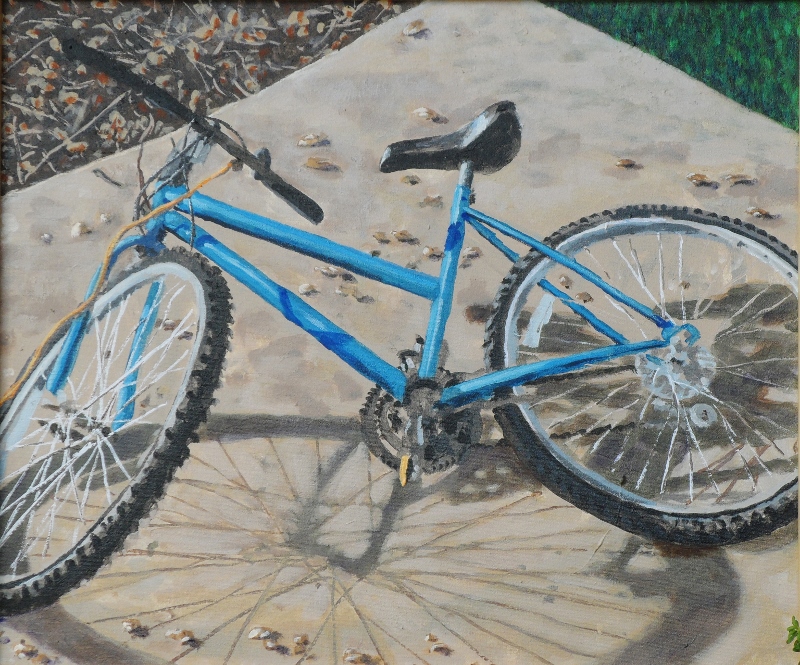
The Blue Bicycle, Acrylic, 20 x 24"
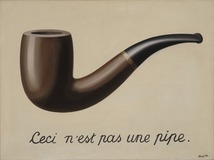
A friend writes: Do you know the Magritte painting, figuring a pipe? Says the legend: "This is not a pipe."
...Which makes sense: it's just an allegory of a pipe, in a poorest dimension as compared to a "real" pipe. I say that, because I wonder why you need to write "Bicycle" as a legend when you paint...a bicycle? 
​
I'd be interested in reading--even briefly expressed--a few words about the context...or the technique you had then chosen and why.
Picture
Dear Denis,
I am indeed familiar with Magritte’s La Trahison des images, 1929, from art history classes and by its presence in the Los Angeles County Museum of Art, of which I was a member during my lengthy residence in that county. (I tell you this in case you would like to see it on your upcoming visit to this country.)

I have my own thoughts about it, but first, here are the words of the museum curator:
​La Trahison des images (Ceci n'est pas une pipe) (The Treachery of images [This is not a pipe]) is one of Rene Magritte's Surrealist masterpieces and an icon of modern art. Heavily influenced by Freudian psychology, Surrealism represented a reaction against the "Rationalism" that some believed led Europe into the horrors of World War I. It attempted to join the realm of dreams and fantasy to the everyday world. Magritte's word-image paintings are treatises on the impossibility of reconciling words, images, and objects. La Trahison des images challenges the linguistic convention of identifying an image of something as the thing itself. At first, Magritte's point appears simplistic, almost to the point of provocation: A painting of a pipe is not the pipe itself. In fact, this work is highly paradoxical. Its realistic style and caption format recall advertising, a field in which Magritte had worked. Advertisements, however, elicit recognition without hesitation or equivocation; this painting causes the viewer to ponder its conflicting messages. Magritte's use of text in his word-image paintings influenced a younger generation of conceptually oriented artists, including Jasper Johns, Roy Lichtenstein, Robert Rauschenberg, Edward Ruscha, and Andy Warhol.
My opinion:
Magritte produced this work at a time in art history when it still was not clear how Painting was going to deal with the challenge of Photography—the defining motivation for art during most of the twentieth century. Surrealism, in addition to defying rationalism, provided an ideal subject matter. It was impossible to photograph a dream!

All art, in fact, had to confront the easy illusionism of photography, in one way or another, in order to claim any kind of significance; and the obvious tactic was first to abandon the field of illusion. I believe that Magritte’s painting represents a deliberate tearing away of painted images from their subjects, by the wonderful contradictory device of joining a realistic image with the words that deny any connection. We can imagine visitors to a museum or gallery saying to one another, “What’s that? Oh, it’s a horse, and there is the barn.” Magritte, and I, insist that “No, the significance of a painted image is not its pipeness or horseness. Look deeper. If you just want to represent a horse, take a photo.”
 
 The war between Painting and Photography is pretty much over. Neither side won, exactly, but Painting has decided to go ahead and work the way she pleases and not let Photography push her around. Photography attempts to argue that her concerns are the same as those addressed by Painting, and Painting lets her believe it.

About my Blue Bicycle, I am not concerned about a viewer saying, “Look, a bicycle,” because it is now general knowledge that a painting does not have to aspire to the realm of the “realistic.” Some paintings do, but they do not have to. So, yeah, this is a painted image of a bicycle. You look at it and you do see an image of a bicycle, so why not call it that?

Many painters choose to supplement the meaning of their work by using a title that completes a thought, either as a narrative or as an aid to identifying the subject. I don’t often do that, though I’ll admit it sometimes amuses me to choose a title that brings attention to a minor part of the image. For example in the painting Three Little Birds, you have to look for them. I did that in the hope that viewers would look a little more carefully.

These days most of my paintings celebrate something abstract I see: a color relationship, a shape, a space. I have worked hard over the last few years to remember to zoom in on what attracts me to paint something in the first place, rather than including a wide view of its surroundings. In this case it was something about the bicycle.

I don’t care whose bicycle that is, nor what it meant to that person. (Somehow it had found its way to my garage, unclaimed by any family member, and I kept it, but that is not significant either.) One day I was practicing blind contour drawing and chose that bicycle, but as I was drawing I was knocked out by its particular blue color. A few days later I decided to paint it (or, rather, its image) and set it out in the driveway. I noticed that it cast interesting shadows, and hence their outline became part of my concept. I moved the bicycle this way and that, seeking the most interesting interplay between bicycle and silhouette. I also walked around the setup again and again, seeking the best point of view.

(An amusing side story. My friend and neighbor, a neat-as-a-pin Austrian, told me that she had seen the bicycle lying in the driveway for several days and very nearly picked it up!)

In creating the actual painting I was faithful to the blue, though the exact luminosity was impossible to capture, since its appeal depends partially on the fact that it changes as one moves. To emphasize the blue I included an orange bungee cord and the yellow reflector on the pedal. The color of the driveway also sets off the color of the bicycle. It turns out, then, that color and shape relationships are the subjects of this painting.
​
If you come up close to The Blue Bicycle you will see that I am completely unconcerned with slick realism; I painted the spokes freehand and left them lumpy to make certain that the viewer understands that a photographic image is not my intent. When I leave my painting clumsy like that it is the best way I know to signal that glossy illusionism is not the point. Besides I like the way it looks. The viewer can enjoy the brushwork as evidence of my process, but I hope she will also enjoy the aspects of the painting with which I did take great pains.

​Sorry--not brief. I hope you find this interesting and helpful!
2 Comments

Painter's Paralysis

1/11/2016

2 Comments

 
Last week I finished what I believe to be my very best painting ever. No, you can’t see it yet because…well, I’ll explain.
​
There are a good number of paintings I have been talking myself out of making. Why? Not sure, but it may be because at some level I have bought into the notion that I must not do what I want to do. Anyway, there are several such paintings in limbo. Because I have twice allowed myself as a young man to be persuaded by self-appointed superior artists to completely change my direction, and now find myself still susceptible to the least comment, positive or negative, I have decided, with the help of my true superior Edward Povey, to work in seclusion. This makes it really easy to work on anything, because nobody is ever going to see anything—not for a while, anyway. Edward thinks he is going to see them, but ha ha.

So far this new strategy has been working well. I have found it much easier to start paintings and to work them in a manner which would have been unfathomable in the recent past. It’s not a perfect solution; I do still have to encourage myself in order to get started, but I have managed to execute a handful of paintings that have turned out to have higher meaning for me. My excitement in painting those harks back to the old days when painting was new and not yet fraught with the threat of put-downs.

 Two of these paintings reach a level above any I have attained before. The difference between these works and those previous is not earth-shattering at all; it may be barely visible to most people. To me the evolution is profound.
And now comes the hard part. A negative voice inside me suggests, “These aren’t so great. They are not groundbreaking at all. You could see work of this stature in a magazine illustration.”

That may be true, I admit, and yet there have been some pretty good magazine illustrations. And besides, so what? I am improving, and in a direction that few illustrations go. And you could say of a heck of a lot of good paintings that they would make good magazine illustrations.

And now the greatest difficulty. That painting, my best ever, intimidates me. At the moment I have no better ideas than that one. Knowing that I will not reach that level again for a while (though I do believe I surely will eventually), makes it almost impossible to start a new painting. And if you are a painter or critic who wants to say to me, “Just do it anyway,” I don’t need to hear that just now. I do not accept much of the nonsense spouted these days about how people should paint—but that’s for another blog entry.

So let me tell you, it took a long time and a great deal of self-persuasion to undertake my next painting. I am sort of happy to announce that I did manage to do so, with tremendous difficulty, and that the new painting is finished and sitting for my viewing in the studio. Sort of happy because, no, this is not the romantic happy ending (and I knew it would not be) of the painter discovering that his next undertaking was outrageously successful, despite his pessimism. I knew this painting would not be my very best again, and it isn't. It does not have the conception or meaning that its predecessor has. But still it's pretty good. These paintings are getting better all the time.
​
And in one very important respect this painting is a great success, because I did it. I overpowered my negative concerns and decided to paint it just to see what this one would look like.  That should make the next one easier to take up.
2 Comments

To Friends

1/7/2016

0 Comments

 
Pablo Picasso said that every artist was his friend. I am delighted to be Picasso's friend and I, too, consider every artist my friend, with gratitude toward every one who reciprocates the feeling. I also embrace every viewer of art as a friend--not just aesthetes but anyone who takes the care to see--because presenting to an audience is the final and a very important component of the creative act. And really, how can an artist not love an engaged seeker of deeper visual comprehension?

So sometimes I wish to share a bit about my artistic intentions, especially since I often seem to be a little divergent. Others may like that about me; I am not so thrilled with it, and maybe if now and again I explain myself and what I am doing it will help close that conceptual gap.  

It's disturbing to watch people walk right by pieces with which I am deeply satisfied, then rave about works that are, I suppose, more accessible--but not so exciting to me. It's also disturbing when people like my paintings for the "wrong" (none of it is really wrong, though) reasons, and miss the qualities that are potentially more meaningful.

Please do understand that I am grateful for any connection with viewers of my art. I hope not to come across teachy because that is not my intent. My sole purpose is to strengthen our connection.

Thank you, my friend, for finding me here.
0 Comments
Forward>>

    Verbiage

    Sometimes you just have to talk about ideas. Well, I do anyway.

    Archives

    March 2019
    February 2019
    January 2019
    December 2018
    September 2018
    August 2018
    January 2018
    December 2017
    August 2017
    July 2017
    June 2017
    May 2017
    December 2016
    October 2016
    September 2016
    July 2016
    June 2016
    May 2016
    March 2016
    February 2016
    January 2016

    Categories

    All

    RSS Feed

Proudly powered by Weebly